Riyadh sits in the middle of the Arabian Peninsula, hundreds of kilometres from either coast, so almost every visitor arrives by air at King Khalid International Airport (RUH, widely called KKIA). Once you are here the challenge is scale: the city spreads across well over a thousand square kilometres. The metro that opened in 2024–25 has changed how visitors get around, but you will still use ride-hailing apps a great deal.
The main ways in, compared
| How | Time | Rough cost | Good to know |
|---|---|---|---|
| International flight to RUH | Europe ≈ 6–7 h; Gulf hubs ≈ 1–2 h | Varies | Many direct routes; airport about 35 km north of the centre |
| Metro from the airport | Roughly 30–45 min into the city | Low flat fare | Yellow Line; change at KAFD for Olaya |
| Taxi, Uber or Careem from the airport | About 30–50 min | Moderate — check the app | Easiest with luggage or late at night |
| Domestic flight (Jeddah, AlUla, Abha) | About 1.5–2 h | Often inexpensive | Frequent services on several airlines |
| Train from Dammam | About 4 h | Low to moderate | Via Hofuf; Riyadh station is east of the old centre |
| Car from Dammam or Bahrain | About 4–5 h | Fuel is cheap | Fast multi-lane highway across open desert |
Visas
Saudi Arabia introduced a tourist e-visa in 2019. Citizens of several dozen countries — including the United Kingdom, the United States, Canada, Australia, the Schengen states, China and Japan — can apply online in a few minutes, and many can also obtain a visa on arrival. The standard tourist visa has been valid for a year, allows multiple entries and permits stays of up to 90 days in total. The fee includes mandatory medical insurance.
- Apply only through the official Saudi visa portal linked from the Visit Saudi website. Third-party sites charge more for the same thing.
- Travellers of other nationalities who hold a valid, used visa for the US, the UK or the Schengen area, and residents of some countries including the Gulf states, may also qualify for an e-visa or a visa on arrival. Conditions apply.
- Your passport should be valid for at least six months from the date of arrival.
- Eligibility lists, fees and conditions change. Check the official source shortly before you book flights.
Arriving at King Khalid International Airport
KKIA lies about 35 kilometres north of central Riyadh. It has five terminals, and international flights use more than one of them, so check which terminal your airline uses — the walk or shuttle between terminals takes time. Immigration is generally quick with an e-visa; fingerprints and a photograph are taken on first entry.
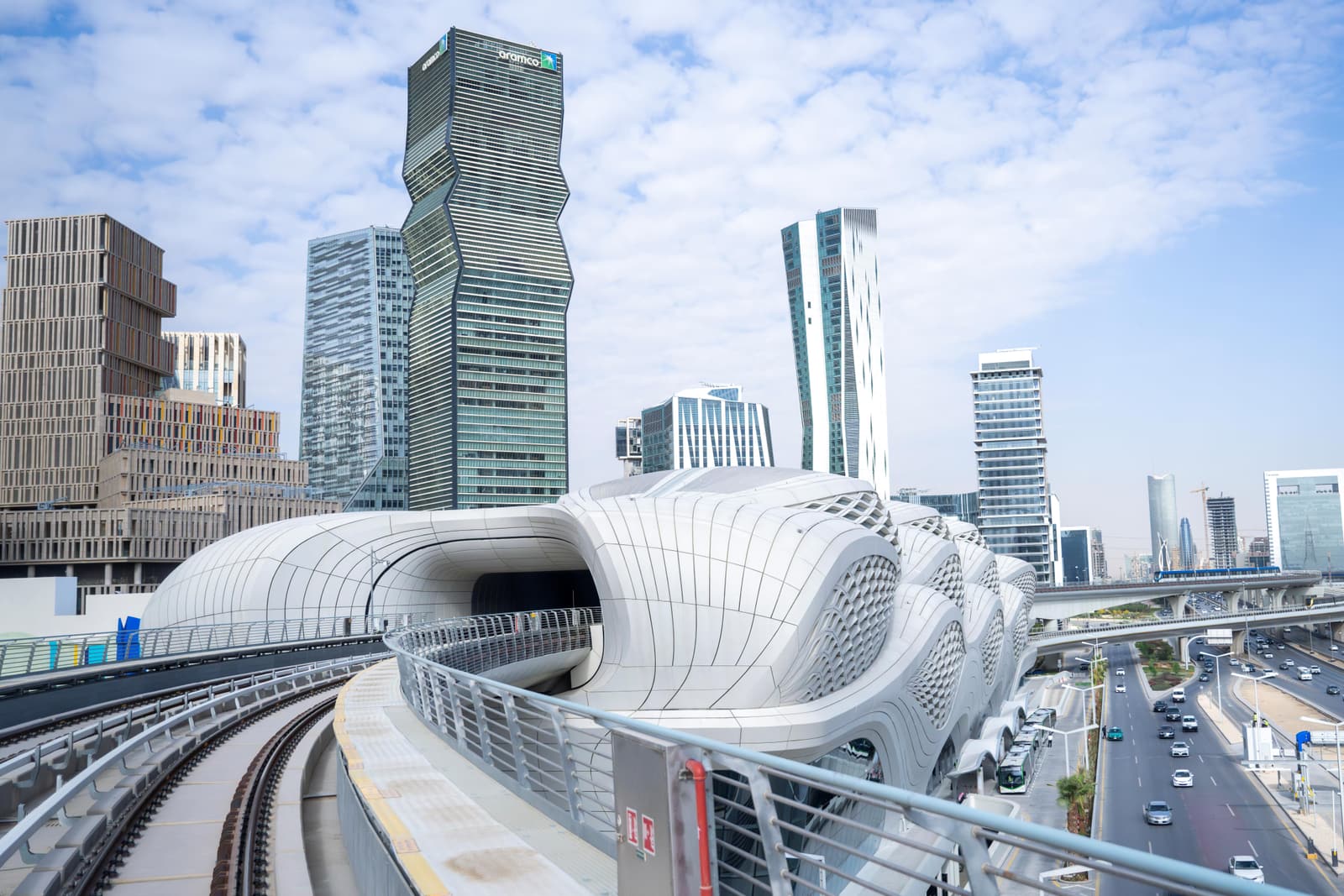
- Metro: the Yellow Line (Line 4) links the airport terminals with the KAFD interchange, where you change for the Blue Line down Olaya to the old centre. It is cheap, air-conditioned and avoids the traffic. Check the first and last trains if you land very early or late.
- Uber and Careem: both work well at the airport and are usually the simplest choice with luggage. Follow the signs to the ride-hailing pickup area.
- Airport taxis: official taxis wait outside arrivals. Make sure the meter is used or agree the fare first.
- Pre-booked transfer: a fixed-price car with a driver waiting in arrivals is the least stressful option after a night flight. See transfers and tours.
- Car hire: all the major companies have desks. See the notes on driving below before you commit.
The Riyadh Metro
The Riyadh Metro opened in stages between December 2024 and early 2025. It is one of the largest driverless systems in the world: six colour-coded lines, around 85 stations and some 176 kilometres of track, a mix of tunnel and viaduct.
- Blue Line (1): the most useful for visitors. It runs north–south along Olaya Street and King Fahd Road, from the north of the city past KAFD, Kingdom Centre and Al Faisaliah to the National Museum and the old centre at Qasr Al Hokm.
- Yellow Line (4): the airport line, running to KAFD.
- Red (2), Orange (3), Green (5) and Purple (6): east–west and cross-city lines that are handy for specific districts. The Orange Line also passes through Qasr Al Hokm.
- Tickets: fares are time-based passes — a two-hour ticket costs only a few riyals, and multi-day passes are available. Pay with the Darb app, a Darb card from station machines, or by tapping a contactless bank card. Check current prices.
- Carriages: trains have First Class, Family Class (for women and families) and Individual Class (for men travelling alone). Signs on the platform show where each stops.
- Hours: trains have run from early morning until around midnight. Confirm times in the app.
The metro does not go everywhere: Diriyah, the Diplomatic Quarter, Boulevard City and every desert site still need a car. A network of public buses, using the same Darb tickets, feeds the stations.
Ride-hailing, taxis and driving
Uber and Careem are how most visitors — and many residents — get about. Cars are plentiful, fares are reasonable by international standards and you avoid any need to negotiate. Other apps also operate. Allow generous time: the evening rush, roughly from 4 pm to 8 pm, can double a journey, and after big events it can be hard to find a car.
Hiring a car makes sense for day trips on tarmac, such as Ushaiqer or the Red Sand Dunes. Fuel is cheap and the highways are excellent, but city driving is fast and assertive, lane discipline is loose and speed cameras are everywhere. Visitors can normally drive on a valid foreign or international licence. Do not take an ordinary hire car off-road.
On foot
Riyadh was built for cars. Distances are long, pavements are patchy and for half the year the heat rules out walking any distance by day. The exceptions are worth knowing: the old centre around Masmak and Deira, KAFD, the Diplomatic Quarter, Diriyah and Bujairi Terrace, and the Boulevard districts are all pleasant to explore on foot in the evening.
Onward travel in Saudi Arabia
Domestic flights are the practical way to reach Jeddah, AlUla, Abha, Madinah and the Red Sea coast. Trains run east to Hofuf and Dammam and north towards Qassim and Hail. Long-distance buses cover the whole country but journeys are long.